Why Most Auto Repair Center Websites Fail at Converting High-Ticket Electrical Leads
In the competitive landscape of the independent automotive aftermarket, there is a hidden goldmine that many shop owners overlook: complex electrical diagnostics. While most car repair shops focus their marketing efforts on high-volume, low-margin services like oil changes or tire rotations, the real profit lies in solving the “unsolvable” electrical gremlins. However, there is a significant problem. You might be driving traffic to your site, but if you aren’t converting those high-ticket electrical leads, you are leaving thousands of dollars on the table every month. My name is Mark Pfleghaar, and I’ve spent my career helping independent shops bridge the gap between digital traffic and actual bay occupancy. I’ve seen firsthand that while Facebook lead gen costs can be as low as $3 per lead in some markets, converting a complex electrical job requires a vastly different psychological approach than a commodity service. The failure isn’t usually in the “reach” – it’s in the “trust gap” present on your website.
The Psychology of the Electrical Customer: Fear vs. Certainty
To understand why your auto repair center website might be failing, we must first dive into the mind of the electrical customer. Unlike the customer seeking a brake pad replacement – who generally understands the scope and cost of the work – the electrical customer is often in a state of high anxiety. They are dealing with “electrical gremlins”: flickering dashboard lights, parasitic battery drains, or intermittent starting issues. These problems represent the “unknown,” and the unknown is terrifying to a consumer’s wallet.
Most websites fail because they treat electrical services as just another checkbox on a list of services. This is a “commodity” mindset. To win high-ticket electrical work, your website must pivot to a “specialist” mindset. The customer isn’t looking for a mechanic; they are looking for a diagnostic surgeon. They are terrified of open-ended diagnostic fees and the “parts cannon” approach where a shop replaces expensive modules without a guaranteed fix. If your website doesn’t explicitly address these fears, the user will bounce. You must move from saying “we fix cars” to “we solve complex electrical puzzles with precision.” This shift in messaging is critical because the psychology behind why users click the call-to-action on some sites but not yours often boils down to which shop made them feel the most “certain” about a successful outcome. High-ticket leads require high-level certainty. When a customer feels that you have a documented process for discovery, they are far more likely to accept a $150 or $300 diagnostic fee without hesitation.
Furthermore, the electrical customer is often a “referral-quality” lead. If you solve an electrical issue that three other shops couldn’t fix, you haven’t just earned a repair order; you’ve earned a customer for life. But to get them through the door, your website needs to project an aura of technical superiority. This means moving away from generic promises and toward specific diagnostic narratives that resonate with the frustrated vehicle owner.
Technical Friction: Why Your Mobile Site is Killing Your Car Electrical System Repair Leads
If a customer is searching for car electrical system repair, there is a high probability they are doing so under duress. Perhaps their car didn’t start in the office parking lot, or their headlights failed during a rainy commute. In these moments, they are almost certainly using a mobile device. This is where “Technical Friction” becomes a silent killer of your conversion rates. Research consistently shows that in the automotive industry, slow loading times and poor mobile optimization are the leading causes of high bounce rates. If your site takes longer than two seconds to load, you’ve already lost the lead to the auto repair shop down the street whose site is faster.
One of the most common mobile mistakes I see is a violation of the “thumb-zone rule.” When a user is stressed, their motor skills degrade. If your “Call Now” or “Schedule Appointment” button is tucked away in a tiny hamburger menu or positioned at the very top of the screen where a thumb can’t reach it comfortably, you are creating friction. For a customer needing a car electrical system repair, the ability to click one large, obvious button to speak to a service advisor is the difference between a conversion and a lost opportunity. Your mobile site shouldn’t just be a “shrunken” version of your desktop site; it should be a streamlined conversion machine designed for one-handed operation.
Beyond button placement, consider the “Context of the Click.” If the user’s car is dead on the side of the road because of a faulty alternator, they don’t want to read a 500-word essay on the history of your shop. They want to know three things: Do you fix this? Are you nearby? How do I talk to you? If your mobile site forces them to hunt for this information, they will hit the “back” button faster than a blown fuse. Technical friction isn’t just about code; it’s about the user’s physical and emotional state at the moment of search.
The “Diagnostic Gap”: Bridging the Knowledge Divide
There is a massive “Diagnostic Gap” on most auto service and repair websites. This gap exists between what the technician knows and what the customer experiences. When I audit shop websites, I often see technical jargon that appeals to other mechanics rather than the consumer. A technician might want to talk about CAN-bus communication errors or oscilloscope waveforms, but the customer is searching for “why does my radio turn off when I hit a bump?”
To convert high-ticket leads, your content must bridge this divide. Use the symptoms the customer is actually feeling. Instead of a page titled “Electrical Diagnostics,” try a section titled “Solving Your Car’s Electrical Mysteries.” List the common symptoms: “Windows that won’t roll up,” “A battery that dies overnight,” or “Warning lights that come and go.” By mirroring the customer’s language, you build immediate rapport. This is the essence of effective auto service and repair marketing. When the customer sees their specific problem described on your page, they feel “seen” and “understood.”
This approach also serves your SEO strategy. Many shops miss out on valuable traffic because they only optimize for broad terms. However, the simple way to optimize for long-tail keywords without being repetitive is to focus on these symptom-based queries. A customer searching for “dashboard lights flickering on Honda Odyssey” is a much “hotter” lead than someone searching for “mechanic.” By addressing the symptoms, you fill the diagnostic gap and position your shop as the logical solution to their specific headache.
High-Ticket Hurdles: ADAS and Modern Vehicle Electronics
The landscape of vehicle electronics has changed more in the last five years than in the previous twenty. We are no longer just dealing with starters and alternators; we are dealing with Advanced Driver Assistance Systems (ADAS). If your auto repair center website doesn’t mention ADAS, calibration, or complex sensor arrays, you are signaling to the owners of modern vehicles that your shop is outdated. This is a major hurdle in capturing high-ticket leads from late-model vehicle owners who are often the highest spenders.
Failing to highlight your investment in ADAS equipment and training is a massive missed opportunity. When a customer with a 2022 Audi sees a “Pre-Collision System Malfunction” warning, they aren’t going to take it to a shop that looks like it stopped learning in 1995. Your website needs to showcase your diagnostic technology. Mentioning your Bosch, Snap-On, or Autel diagnostic platforms – and explaining *why* they matter for the customer’s safety – builds the “Trust Factor” necessary for high-ticket sales. If you aren’t actively marketing these capabilities, you should read more on why your auto repair shop is losing the battle for high-ticket ADAS leads.
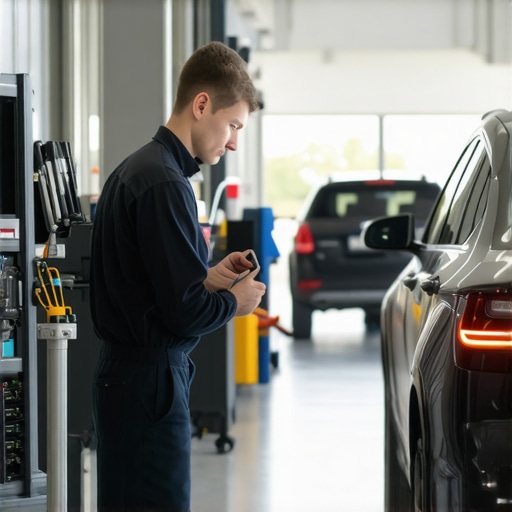
The modern auto repair shop is essentially a high-tech data center on wheels. Your website should reflect that. This means including high-quality imagery of your technicians using tablets and diagnostic interfaces, not just wrenches and hammers. When a customer sees that auto repair shop professionals are using the same level of technology that built their car, the “Trust Gap” begins to close. ADAS isn’t just a service; it’s a proof of concept for your entire electrical department.
SEO vs. CRO: Why Ranking #1 for “Auto AC Repair Near Me” Isn’t Enough
Many shop owners are obsessed with SEO. They want to rank #1 for auto ac repair near me, and while that is important, ranking is only half the battle. This is the difference between Search Engine Optimization (SEO) and Conversion Rate Optimization (CRO). You can win the “near me” battle by appearing at the top of Google, but you can still lose the war if your landing page is generic, cluttered, or untrustworthy.
Imagine a customer searching for auto ac repair near me. They click the first result, and it’s a page with a generic stock photo of a smiling mechanic holding a wrench. There is no mention of specialized AC leak detection, no explanation of R-1234yf refrigerant capabilities, and no clear path to book an appointment. That customer will likely leave and click the second result – a shop that shows a real photo of their AC recovery machine and offers a “Digital Inspection Report” with every diagnostic.
To truly dominate your local market, you must understand the specific local signals that help auto repair shops win the ‘near me’ battle. These signals aren’t just keywords; they are trust signals. Reviews that specifically mention “electrical repair” or “diagnostic accuracy” are worth their weight in gold. If your website doesn’t curate and display these specific testimonials on your electrical service pages, you are failing at CRO. SEO gets them to the door; CRO gets them to drop off their keys. High-ticket electrical work requires a website that acts as a silent salesman, answering objections before the customer even picks up the phone.
The Blueprint for a High-Converting Electrical Service Page
If you want to stop losing these leads, you need a blueprint for your service pages. A high-converting electrical page for car repair shops should include the following elements:
- Real Photos of Diagnostic Equipment: Ditch the stock photos. Show your actual shop, your actual scanners, and your actual technicians. This proves you have the “skin in the game” to handle complex work.
- Clear Explanation of the Diagnostic Fee: Don’t hide from the fee. Explain that “Testing, not guessing” saves the customer money in the long run. Transparency is the ultimate trust builder.
- Trust Signals (ASE Certifications): Explicitly mention L1 Advanced Engine Performance Specialists or other electrical certifications. These are the “doctorate degrees” of the automotive world.
- The “Thumb-Zone” Schedule Button: Ensure your “Schedule Now” button is prominent, easy to hit on mobile, and leads to a simple, non-intimidating form.
- Symptom-Based Content: Use bullet points to list common electrical issues so the customer can say, “Yes, that’s exactly what my car is doing!”
By following this blueprint, you transform your car repair shops‘ digital presence from a static brochure into a dynamic lead-conversion tool. Remember, the goal is to make the customer feel that their vehicle is in the hands of experts who have a systematic approach to solving their problem. You can see examples of well-structured service layouts at car repair shops that prioritize user experience and technical clarity. Every element on the page should serve the goal of reducing the customer’s anxiety and increasing their confidence in your expertise.
Conclusion: Turning Clicks into Key Drops
Converting high-ticket electrical leads isn’t about having the flashiest website; it’s about having the most trustworthy and functional one. Electrical leads are won through a combination of technical transparency, mobile-first design, and a deep understanding of the customer’s psychological state. If your auto repair center website is currently a “leaky bucket,” no amount of expensive SEO or PPC will fix your bottom line. You must audit your mobile experience, bridge the diagnostic knowledge gap, and lean into the modern world of ADAS and vehicle electronics.
If you are ready to stop guessing and start converting, I invite you to reach out for a comprehensive marketing audit. We can look at your current site speed, your “thumb-zone” accessibility, and your content strategy to ensure you aren’t just getting clicks, but actually turning those clicks into key drops. My name is Mark Pfleghaar, and I specialize in helping independent shop owners like you dominate the high-ticket diagnostic market. Let’s work together to make your shop the go-to destination for electrical excellence in your community.