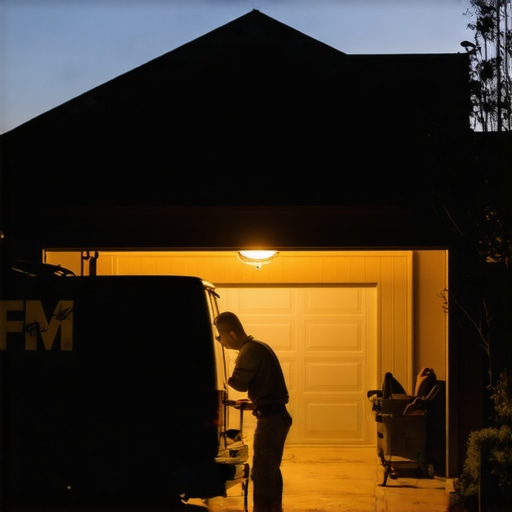
The Specific Proximity Signals That Help Emergency Garage Door Companies Outrank National Franchises
In the high-stakes world of local service SEO, the battle for the top spot on Google is often described as a “David vs. Goliath” scenario. On one side, you have massive national franchises with million-dollar marketing budgets, centralized call centers, and domain authority that spans the entire country. On the other side, you have the local independent shop – a business that might only operate within a thirty-mile radius. However, when a homeowner’s garage door spring snapped at 2 AM, the rules of engagement change. They aren’t looking for a corporate brand; they are looking for the fastest, most reliable technician who is currently five miles away.
While the national franchises have the “Goliath” budget, they often suffer from a lack of “proximity relevance.” They struggle to convince Google’s algorithm that they are the most qualified entity for a hyper-local, urgent request. As we move through 2025 and into 2026, keyword data shows that “Emergency [City] Garage Door Repair” has become a top-tier transactional phrase, commanding some of the highest cost-per-click (CPC) rates in the industry. Local companies are winning this war by optimizing for specific proximity signals that Google’s algorithm prioritizes for “near me” and “emergency” searches. This article explores how local businesses can leverage these signals to dominate their market.
The Proximity Paradox: Why Big Brands Often Lose the Local War
National brands typically rely on a “hub-and-spoke” content strategy. They create one massive website and then generate thousands of nearly identical location pages. While this builds overall domain authority, it creates a “cookie-cutter” problem. These pages often lack the local nuance, specific geographical landmarks, and community-level data that Google uses to determine local relevance. This is known as the Proximity Paradox: as a brand gets larger, its digital presence often becomes more diluted and less relevant to the specific needs of a neighborhood.
To outrank these giants, local businesses must focus on “Hyper-Local Relevance” rather than “National Authority.” This involves more than just putting a city name in a title tag. Mastering Technical SEO in 2025 involves deep entity association – connecting your business to local geographic coordinates, local events, and specific neighborhood data. When a user searches for local garage door repair, Google isn’t just looking for the biggest company; it’s looking for the most “situated” company. By proving you are an integral part of the local infrastructure, you create a signal that national franchises simply cannot replicate with a template.
Furthermore, local businesses can respond to algorithm shifts faster. While a national franchise might take months to update their Branding Mastery strategy across 500 locations, a local shop can pivot their messaging to reflect local weather patterns (which often cause garage door failures) or local construction trends within days. This agility is a core component of maintaining proximity dominance.
Hyper-Local Service Pages & The Neighborhood Signal
One of the most effective ways to signal proximity is through the creation of hyper-local service pages. These are not generic “City, State” pages; they are pages dedicated to the specific suburbs and neighborhoods where your customers live. For a company based in the Coachella Valley, for instance, having dedicated pages for localgaragedoorpalmdesert.com, localgaragedoorpalmdesert.com, and localgaragedoorpalmdesert.com is essential. These pages should act as a digital storefront for that specific community.
To truly signal proximity to Google, these pages must include:
- Local Landmarks and Directions: Mentioning that you are “located just north of the Indian Wells Tennis Garden” or “serving neighborhoods near the Palm Springs Aerial Tramway” helps Google’s NLP (Natural Language Processing) associate your business with those specific coordinates.
- Neighborhood-Specific Testimonials: Displaying a review from a customer in a specific gated community or neighborhood provides social proof and geographic confirmation.
- Local Zip Codes: Listing the specific zip codes you serve within a city helps refine your “service area” in the eyes of the algorithm.
When creating a garage door installation service page for a specific city, it is highly beneficial to include local permit information or common architectural styles found in that area. For example, a new garage door installation page for a desert community might focus on heat-resistant materials and Mediterranean aesthetics, whereas a page for a coastal town would focus on salt-air corrosion resistance. This level of detail signals to Google that you aren’t just a national brand with a landing page – you are a local expert with specialized knowledge of the area’s unique requirements.
Converting the “Snapped Spring” Urgency: Transactional SEO
The psychology of emergency garage door repair is rooted in immediate need. When a homeowner finds their garage door spring snapped, they are often physically trapped – either their car is stuck in the garage or their home is unsecured. In these moments, the user’s click-to-call intent is over 90%. They are not browsing; they are buying.
To capture this traffic, your SEO strategy must prioritize transactional keywords like urgent garage door repair and same day garage door repair. These phrases signal to Google that the user is in a “crisis state.” Local companies have a massive advantage here because they can promise – and deliver – faster response times than a national franchise that has to route calls through a central dispatcher.
Data from over 165 industry case studies suggests a “Hidden Response Gap.” Google tracks “call from search” metrics and “user return to search” rates. If a user clicks a national franchise’s ad, finds out they can’t send a tech for 48 hours, and then returns to the search results to click a local shop, Google notices. High-intent phrases like garage door spring snapped should lead to pages that emphasize 24/7 availability and immediate dispatch. This alignment between user intent and business capability is a powerful ranking signal that rewards local proximity.
Furthermore, our research into PPC Campaigns Unlocked shows that combining Local Service Ads (LSAs) with organic proximity signals creates a “halo effect.” When a user sees your local business in the LSAs, the Map Pack, and the organic results for an emergency garage door repair search, your conversion rate skyrockets because you have established yourself as the dominant local authority.
Google Maps & Review Velocity: The Engine of Local SEO
The Google Business Profile (GBP) is the most critical asset for any local garage door service. However, many businesses make the mistake of thinking that the total number of reviews is the only metric that matters. In reality, “Review Velocity” (how often you get new reviews) and “Local Keyword Density” (the words used in those reviews) are often more important for outranking national competitors.
A local shop with 50 reviews – five of which were posted in the last week – will often outrank a national franchise with 500 reviews, the last of which was posted three months ago. Google prioritizes businesses that are currently active and popular in the community. To maximize this, businesses should actively encourage customers to mention the specific service provided, such as garage door opener repair services, and the specific neighborhood in their review. This creates a feedback loop: a customer mentions “best emergency garage door services in La Quinta,” and Google’s algorithm uses that review to further cement your proximity signal for that area.
It is also vital to avoid shortcuts. We have discussed Why Most CTR Manipulation Tools Fail to move local rankings in the long term. Google’s ability to detect artificial “clicks” or “check-ins” has become highly sophisticated. Authentic local signals – such as real customers leaving reviews from their own devices at their home addresses – are the only sustainable way to build authority in the Map Pack. National franchises often struggle with this because their reviews are spread thin across hundreds of locations, whereas a local shop can focus its “review energy” on a single, powerful profile.
Technical Local Signals: Schema & Mobile UX
While content and reviews are the “face” of your SEO, technical signals are the “foundation.” For a local business, this means implementing robust LocalBusiness Schema. This is a specific type of structured data that tells Google exactly where you are, what your hours are, and what services you offer. By explicitly defining your service area and linking your schema to your garage door opener repair services, you provide the algorithm with the raw data it needs to verify your proximity.
Mobile User Experience (UX) is equally critical. Most leads for overhead garage door repair originate from mobile devices, often while the user is standing in their driveway looking at a broken door. If your website takes more than three seconds to load or has a confusing layout, that user will bounce. Following Web Design Trends 2025, your mobile site should feature a prominent “Click-to-Call” button, an easy-to-use booking form, and fast-loading images of your local team.
Technical optimization also includes ensuring your site is ready for garage door opener installation searches by having clear, crawlable service menus. Google needs to see that you are an expert in the hardware (the openers and springs) as well as the service (the installation and repair). A fast, mobile-friendly site that clearly outlines your garage door installation service capabilities will always have an edge over a slow, bloated corporate site that is trying to rank for ten different industries at once.
Conclusion: Claiming Your Territory
Proximity is no longer just about physical distance; it is about the digital signals that prove you are an active, trusted, and essential part of a local community. National franchises may have the brand recognition, but local garage door companies have the advantage of relevance. By building hyper-local service pages, focusing on review velocity, and optimizing for high-intent emergency keywords, local shops can effectively “claim their territory” on the search engine results page.
The key is to stop trying to beat the national brands at their own game of “mass authority” and instead force them to play your game of “local expertise.” When you align your technical SEO, your content strategy, and your customer feedback loop around the specific needs of your city, you create an unbeatable proximity signal. Whether a customer needs a simple tune-up or a full garage door replacement, being the “nearest and best” choice is the ultimate winning strategy in 2026.
If you are ready to audit your own local signals or want to develop a professional SEO strategy that puts your business at the top of the Map Pack, contact the experts at Growth Digital Co today. We specialize in helping local service businesses outmaneuver the giants and capture high-value leads through precision-targeted digital marketing.