The Specific Proximity Signals That Help Excavation Contractors Win More Foundation Digging Leads
In the high-stakes world of heavy civil construction and residential site prep, the battle for the next big contract isn’t just fought with the best equipment or the lowest bid – it’s fought on the digital map. Today, when a developer or a homeowner realizes they need site work, their first move isn’t to check the Yellow Pages; it’s to pull out a smartphone and search for excavation contractors near me. This “near me” revolution has fundamentally shifted how leads are generated in the excavation industry. If your business isn’t appearing in those crucial moments, you are effectively invisible to the highest-intent customers in your service area.
Winning more foundation digging and septic leads requires more than just being a good operator; it requires mastering “proximity signals.” These are the specific data points that search engines like Google use to determine how close your business is – both physically and digitally – to the person searching. In this deep-dive, we will explore how you can optimize these signals to ensure you are the first call made when a foundation needs to be poured or a septic system fails.
Defining Proximity Signals in the Heavy Equipment Niche
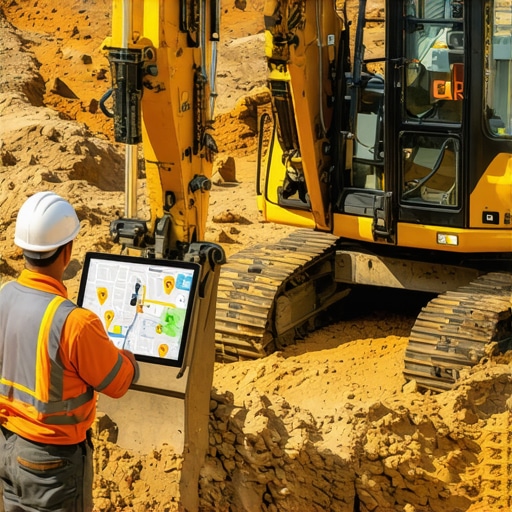
In the field, proximity signals usually refer to safety protocols, such as hazardous proximity zones around heavy machinery where workers are at risk. However, in the world of digital marketing, proximity signals are the metrics Google uses to calculate the distance between the searcher’s current location and your verified business address. For excavation contractors near me, these signals are the most powerful ranking factors in the Local 3-Pack.
Google looks at three primary pillars for local search: Relevance, Prominence, and Proximity. While you can influence relevance through your website content and prominence through reviews and backlinks, proximity is often seen as the “fixed” variable. However, it is more dynamic than most contractors realize. It’s not just about the miles between your shop and the customer; it’s about how clearly you communicate your service area to the search engine. Just as you wouldn’t ignore septic system maintenance for your fleet, you cannot afford to ignore the digital maintenance of your location data.
Why Foundation Digging Leads are Distance-Sensitive
Foundation digging and site preparation are unique among home services because of the sheer logistics involved. Moving a 20-ton excavator, a skid steer, and a dump truck requires significant mobilization time and fuel costs. Customers, especially savvy general contractors, understand this. They search for local providers because they know that a contractor located 50 miles away will likely have higher mobilization fees than one located 5 miles away.
When someone searches for land clearing services or general excavation services, Google’s algorithm prioritizes local results to provide the most cost-effective and timely options for the user. If your digital proximity signals are weak, Google might bypass your business in favor of a competitor who is actually further away but has better-optimized local data. This is often referred to as a “proximity error,” a concept we’ve explored in detail regarding other industries, such as in our analysis of The Proximity Error Keeping Your Garage Door Repair Shop Out of the Local 3-Pack. In excavation, this error translates directly to lost revenue on high-ticket foundation projects.
The Google Business Profile (GBP): Your Primary Proximity Beacon
Your Google Business Profile (formerly Google My Business) is the single most important tool in your arsenal for capturing local leads. It acts as a digital beacon, telling Google exactly where you are and what you do. For an excavation business, simply having a profile isn’t enough. You must optimize it to dominate the map pack.
First, ensure your primary category is set correctly (usually “Excavating Contractor”) and use secondary categories like “Septic Tank Service” or “Land Leveling Service.” One of the most common mistakes is failing to define a clear service area. If you operate out of a home office or a yard without a showroom, you can set a service area radius. However, the physical address you verify with Google still acts as the “center” of your proximity circle. To learn more about navigating these requirements, check out our guide on How to dominate the map pack without having a massive physical office.
Beyond Google, ensuring your business is accurately listed on Apple Business Connect and Bing Places is essential. These listings provide “NAP” (Name, Address, Phone number) consistency, which reinforces your proximity signals. If your address is listed as “123 Main St” on Google but “123 Main Street” on another directory, it creates a tiny bit of friction in the algorithm’s confidence in your location.
Hyper-Local Content: Beyond the City Name
To win foundation leads, you need to prove to Google that you are an expert in your specific geography. This goes beyond just mentioning your city name in the footer of your website. You need to create content that discusses the specific conditions of your local area. For example, writing about the specific soil types in your county – and how they affect septic tank installation or foundation stability – sends a massive proximity signal to search engines.
Consider creating dedicated pages for specific neighborhoods or surrounding towns. If you offer sewer line repair in a specific historic district where the pipes are known to be clay and prone to failure, write a page specifically about that. This hyper-local approach helps you rank for searches in those specific pockets of your territory. When you build out these pages, remember that The local citation sources that actually move the needle for your business are those that are geographically relevant, such as local chamber of commerce links or mentions in neighborhood blogs.
Using a resource like blslandandsepticllc.com as a benchmark, you can see how categorical clarity in services – ranging from septic drain field repair to septic tank replacement – helps define a business’s local footprint. By detailing every service offered, you provide more “hooks” for local searchers to find you.
Technical Signals: Speed, Schema, and Mobile Usability
Proximity isn’t just about geography; it’s about the user experience for the person in that geography. Most local searches for emergency sewer line repair happen on mobile devices, often from the job site or a front yard. If your website takes ten seconds to load on a mobile connection, Google is unlikely to rank you in the top three, regardless of how close you are to the searcher. Google prioritizes the “best” local answer, and a slow website is a poor answer.
Furthermore, technical SEO elements like Local Business Schema markup are non-negotiable in 2025. Schema is a piece of code that tells search engines exactly what your data means. It explicitly links your phone number, address, and services (like commercial land clearing) in a format that AI and search bots can digest instantly. If your schema is broken or missing, you are leaving your proximity to chance. For a deeper dive into these mechanics, see our article on The technical reason your schema markup isn’t showing in search results and our comprehensive guide on Mastering Technical SEO in 2025: Expert Strategies to Boost Your Website.
Converting Proximity into Profit: The Scott Andreasen Approach
As an expert in excavation business growth, I have seen many contractors waste thousands of dollars on broad advertising campaigns that target people 60 miles away. While it’s tempting to want to “cover the whole state,” the reality of excavation is that your ROI is highest when your travel time is lowest. By tightening your digital proximity signals, you are essentially performing a “surgical strike” on your most profitable leads.
My approach focuses on eliminating wasteful ad spend. Instead of bidding on broad keywords across a massive radius, we use The GMB Ranking Software Tactics That Actually Help Your Business Profile Move Up the Map Pack to dominate the immediate 10-15 mile radius around your yard. This ensures that when someone needs septic tank replacement or a new foundation dug, you are the obvious, local choice. This strategy maximizes the “Lead Proximity Zone,” ensuring that your equipment stays moving and your mobilization costs stay low.
Conclusion: Owning Your Backyard
In the excavation industry, your reputation is built on the ground, but your leads are built in the cloud. Proximity is no longer a static measurement of miles; it is a dynamic set of digital signals that you can – and must – influence. By optimizing your Google Business Profile, creating hyper-local content about septic system maintenance and land clearing services, and ensuring your technical SEO is flawless, you can effectively “shorten” the distance between your business and your next big foundation lead.
Don’t let a competitor from the next county over steal your backyard because their digital signals are stronger than yours. Audit your local presence today. If you’re ready to dominate the Local 3-Pack and maximize your ROI, contact Growth Digital Co for a tailored lead-generation strategy that puts your heavy equipment to work where it belongs: right in your community.