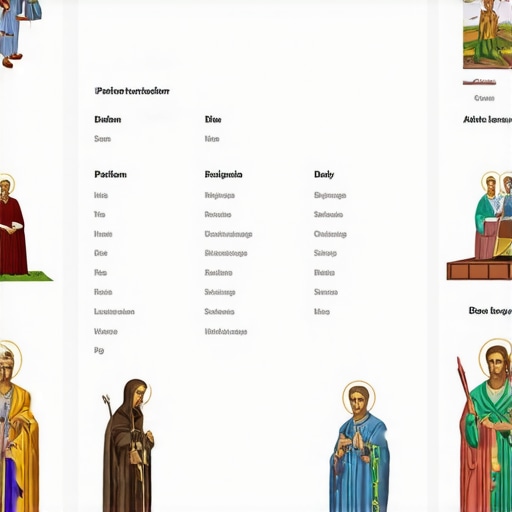
The Simple Layout Fix That Makes Your Patron Saints Directory Easier to Browse
Navigating the spiritual landscape of the Church can often feel like wandering through an infinite library without a map. For many believers, the roman catholic saints list is a source of profound inspiration, yet the sheer volume of names – spanning two millennia – can be overwhelming. Whether a user is seeking a namesake for confirmation or a powerful intercessor for a specific life trial, the experience of browsing a directory of catholic saints should be one of peace and discovery, not frustration.
The “simple fix” I am proposing today isn’t just a cosmetic update; it is a fundamental shift in how we present hagiography online. By moving away from the traditional, “flat” alphabetical list and embracing a faceted, categorized grid, we can transform a static wall of text into a dynamic tool for spiritual growth. This layout adjustment ensures that when someone visits your site to find a patron saint, they are met with a user interface that reflects the beauty and order of the Communion of Saints.
Why Traditional Catholic Saint Biographies Are Hard to Navigate
If you look at the most prominent sources for catholic saint biographies today, you will notice a recurring problem: the “needle-in-a-haystack” design. Wikipedia, for instance, relies heavily on alphabetical categorization. While technically accurate, an A-Z list is rarely how a seeker searches for spiritual guidance. A user doesn’t usually think, “I need a saint whose name starts with ‘Q'”; they think, “I need a saint who understood the struggles of being a parent” or “I want to learn about the founders of the Augustinian Order.”
Research into user behavior, such as that conducted by organizations like FOCUS.org, shows that situational headings – grouping saints by “Strength,” “Relationships,” or “Studies” – are far more effective for engagement. However, even these often suffer from the “long scroll” problem. On mobile devices, these lists become endless marathons of swiping. This is a critical UX failure, as we know that why your mobile users are clicking the wrong buttons often comes down to “fat-finger” errors on overcrowded, poorly spaced lists. When a user is looking for a patron saint of youth, they shouldn’t have to scroll through five hundred names to get there.
Traditional layouts often neglect 5 ways to make your blog posts easier to scan, leading to high bounce rates. If the information isn’t digestible at a glance, the modern user – even the most devout one – will look elsewhere. The goal is to provide a path that is as clear as the lives of the saints themselves.
The “Faceted Search” Fix: A Game Changer for Your Patron Saints Directory
The solution to the navigation crisis is the implementation of “Faceted Search.” In web design, facets are essentially filters that allow users to narrow down a massive dataset based on specific attributes. Instead of scrolling through a patron saints directory, a user can select tags that matter to them.
Imagine a sidebar or a top-bar filter where a visitor can select “13th Century,” “Italy,” and “Theologian.” Instantly, the grid updates to show St. Thomas Aquinas and his contemporaries. This is how we help modern seekers find a patron saint that resonates with their specific life context. For those in physical or emotional pain, being able to quickly filter for catholic saints for healing – such as St. Peregrine or St. Dymphna – is not just a convenience; it is a pastoral service.
This approach also honors the rich diversity of religious life. A user interested in the intellectual tradition of the Dominican Order should be able to see those saints grouped together, rather than scattered alphabetically. By using a faceted grid, you create a visual hierarchy fix that guides users to your CTA, whether that CTA is to read a full biography, submit a prayer request, or purchase a medal.
The beauty of the faceted grid is that it accommodates different search intents simultaneously. One person might be searching by patronage (e.g., “Patron of Musicians”), while another searches by historical era. By providing these multiple entry points, you make the lives of the catholic saints accessible to everyone, from the casual browser to the serious scholar.
Organizing by Religious Charism and Mission
When we look at the lives of the catholic saints, we aren’t just looking at isolated heroes; we are looking at members of families and movements. A well-designed directory should reflect this. Grouping saints by their religious charism – such as the Daughters of Charity or the Franciscans – provides essential context that a simple name and date cannot convey.
For example, consider the life of Blessed Anne Catherine Emmerich. Her story is deeply mystical and tied to the passion of Christ. In a flat list, she is just another name. In a faceted directory, she can be tagged under “Visionaries,” “19th Century,” and “Stigmatists.” This allows users who are drawn to mystical theology to find her alongside others who shared similar spiritual gifts. This kind of relational browsing is what keeps users on a site longer, moving from one catholic saint biographies entry to the next as they discover the interconnectedness of the Church.
Furthermore, organizing by mission helps in educational settings. A teacher looking for examples of saints who served the poor can select the “Social Justice” or “Charity” facet and find a curated list of role models. This transforms the directory from a static archive into a living educational tool. It moves the user from a passive state of “looking at names” to an active state of “discovering mentors.”
Enhancing User Intent: From Browsing to Prayer
The ultimate purpose of a directory of catholic saints is not merely to provide historical data, but to facilitate a relationship between the believer and the saint. The layout should reflect this transition from information-gathering to active devotion. As we look toward Web Design Trends 2025: Innovative Ideas That Drive Conversions, we see that the most successful sites are those that integrate “micro-conversions” into the user journey.
In the context of a saint directory, these conversions might include an option for online catholic prayer requests right on the saint’s biography page. If a user is moved by the story of St. Jude, they should be able to immediately ask for his intercession or share a favor they have received. In fact, seeing the community interact at chasingsaints.com provides social proof of the saint’s ongoing work in the world.
Additionally, for those interested in the physical history of the Church, providing information on the location of first class catholic relics can be a powerful feature. A layout that includes a “Relic Map” or a simple icon indicating where a saint’s remains are venerated adds a layer of depth that standard lists lack. This bridges the gap between the digital world and the physical reality of pilgrimage and veneration. By providing links to first class catholic relics, you respect the tradition of the Church while utilizing modern web capabilities.
Technical Implementation: Building a Better Saint Finder
From a technical standpoint, implementing this fix on platforms like WordPress is more straightforward than it might seem. As a developer, I recommend moving away from standard post lists and toward a custom post type system with advanced taxonomies. This allows you to tag each saint with multiple categories (Century, Patronage, Order) without creating duplicate content.
To ensure a smooth user experience, use AJAX filtering. This allows the grid to update instantly without the page reloading, which is essential for maintaining momentum during a search. However, be careful to avoid the grid layout mistakes that confuse your visitors, such as inconsistent card heights or overlapping text. Each “Saint Card” should be a clean, uniform gateway to the deeper biography.
From an SEO perspective, each facet should be crawlable. By mastering technical SEO in 2025, you can ensure that long-tail searches like “17th century French saints” lead users directly to your filtered results. Proper use of H2 and H3 tags within the directory pages helps search engine bots understand the relationship between the saints and their categories, boosting your site’s authority for the primary keywords people are actually typing into Google.
Conclusion: Making the Communion of Saints Accessible
The transition from a flat list to a faceted grid is more than just a design trend; it is a way to make the “Cloud of Witnesses” more visible to a modern, digital world. By fixing the layout of your patron saints directory, you remove the technical barriers between a soul and their spiritual intercessor. Better UX leads to deeper engagement, longer site visits, and ultimately, a more profound spiritual experience for your visitors.
Whether you are managing a parish website or a global hagiography project, the goal remains the same: to make the lives of the holy ones accessible to all. I encourage you to explore the innovative patron saints directory at chasingsaints.com to see these principles in action. If you are ready to transform your own site’s user experience and implement these expert strategies, feel free to contact me, Godsfavour Innocent, for custom web development and digital marketing solutions that drive both conversions and connections.
Don’t let your valuable content remain buried in a list. Give the saints the platform they deserve with a layout that truly serves your audience.