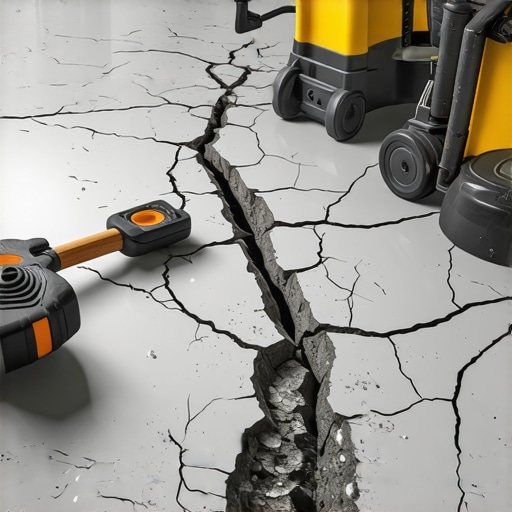
Why Most Epoxy Garage Floor Installers Struggle to Fix Deep Concrete Cracks Permanently
It is a scenario played out in thousands of garages across the country every year: a homeowner hires professional epoxy garage floor installers to revitalize their stained, cracked concrete. The finished product looks like a showroom – glossy, vibrant, and seamless. However, six months later, a familiar jagged line begins to “telegraph” through the beautiful new surface. This is the “Ghost Crack” phenomenon. Despite the aesthetic transformation, the underlying structural issue was never truly addressed. As a manufacturer of high-performance industrial coatings, we at Concrete Floor Coatings see this failure frequently. The hard truth is that most standard installers rely on rigid materials to fix a substrate that is inherently dynamic. This article explores why conventional methods fail and how advanced chemistry provides the only permanent solution for deep concrete cracks.
The Science of Concrete Movement: Why Cracks Happen
To understand why most epoxy floor coating companies fail at crack repair, one must first understand the nature of concrete itself. Contrary to its appearance as a solid, immovable block, concrete is a dynamic material that “breathes” and moves throughout its lifespan. There are two primary types of cracks that installers encounter: Shrinkage Cracks and Settlement Cracks.
Shrinkage cracks typically occur during the initial curing process as moisture leaves the concrete mix. While these are often superficial, they can extend deep into the slab. Settlement cracks, on the other hand, are the result of soil movement, hydrostatic pressure, or heavy load stress. These cracks are “active,” meaning they continue to expand and contract based on the season and the temperature of the ground. When epoxy garage floor installers treat an active settlement crack as a static void, they are setting the stage for future coating failure.
Concrete is subject to thermal expansion and contraction. In regions with significant temperature swings, a garage slab can move several millimeters over the course of a year. If a repair material does not account for this coefficient of linear thermal expansion, the bond will eventually break. Most generic installers lack the geological and chemical understanding to differentiate between a dormant hairline fracture and a structural crack that requires specialized stabilization.
The Rigidity Trap: Why Standard Epoxy Fails on Deep Cracks
The primary reason for the failure of traditional repairs is the inherent brittleness of standard epoxy resins. Many of the best epoxy garage floor installers realize that while epoxy is incredibly strong in terms of compressive strength, it lacks “elongation.” Elongation is the ability of a material to stretch before it breaks.
When an installer fills a deep crack with standard 100% solids epoxy, they are essentially inserting a rigid plastic wedge into the concrete. As the slab shifts due to seasonal changes, the concrete moves, but the epoxy cannot. Because the epoxy is bonded to the sidewalls of the crack, the tension has nowhere to go. Eventually, the stress exceeds the tensile strength of either the epoxy or the concrete itself, leading to a new crack right next to the old one, or a complete delamination of the coating. This is why industrial coatings used in heavy manufacturing environments often move away from pure epoxy for joint and crack treatments, favoring materials that can absorb the energy of a shifting substrate.
Furthermore, many epoxy floor coating companies use “all-in-one” kits that are designed for speed rather than longevity. These products often have high shrinkage rates during their own curing process, which can actually pull away from the edges of the crack before the garage owner even parks their first car on the new floor. To achieve a permanent fix, the chemistry of the repair material must match the mechanical demands of the environment.
The Professional Repair Process: Beyond “Filling the Hole”
A permanent repair requires significantly more labor and specialized equipment than simply pouring resin into a gap. Professional concrete crack repair companies follow a rigorous multi-step protocol to ensure the repair becomes a permanent part of the slab’s matrix.
1. V-Grooving and Mechanical Preparation
You cannot fix a crack by simply covering it. The first step is “chasing” the crack with a diamond-blade saw or a specialized “V-groover.” This process opens the crack into a clean, V-shaped or U-shaped reservoir. This increases the surface area for the bonding agent and ensures that the repair material penetrates deep into the slab rather than just sitting on the surface. Without V-grooving, the repair is merely a “scab” that will eventually peel off.
2. Industrial Dust Extraction
Adhesion is the enemy of dust. When a crack is cut, it produces a massive amount of fine silica dust. If this dust is not removed using HEPA-filtered industrial vacuums, the repair material will bond to the dust particles rather than the concrete sidewalls. This is a common shortcut taken by low-cost installers who lack the proper equipment.
3. Moisture Testing and Mitigation
Deep cracks are often conduits for moisture vapor transmission from the soil beneath the slab. If the moisture content is too high, it will prevent the resin from curing or cause osmotic blistering later. High-tier installers use moisture meters to verify that the slab is dry enough for the specific chemistry being applied. If moisture is present, a moisture-vapor barrier or a moisture-tolerant primer must be used as part of the repair strategy.
Polyurea and Polyaspartic: The Industrial-Grade Solution
While epoxy has its place as a base coat, the modern standard for crack repair and top-tier finishing involves polyaspartic garage floor coating technology. At Concrete Floor Coatings, we emphasize the use of polyurea-based fillers for a specific reason: elongation.
A high-quality polyurea garage floor coating or joint filler can have an elongation rate of 300% or more. This means the material can stretch significantly as the concrete crack expands in the winter and compress as it closes in the summer. Unlike brittle epoxy, polyurea remains flexible for the life of the floor. Furthermore, get-epoxy.com provides materials that cure in a fraction of the time. While epoxy might take 24 hours to harden, industrial polyureas can be rock-solid and ready for grinding in 20 to 45 minutes.
This rapid cure time is not just about speed; it prevents the material from sinking too deep into the soil or “starving” the joint before it sets. When combined with a polyaspartic garage floor coating as a top layer, the result is a floor that is UV stable, impact-resistant, and, most importantly, capable of bridging cracks without fracturing. This is the difference between a residential-grade “paint job” and a true industrial-grade flooring system.
Evaluating Your Contractor: Digital Presence and Professionalism
Choosing the right installer is as much about vetting their business practices as it is about checking their equipment. In today’s market, the most reliable contractors are those who invest in their professional identity and customer education. When searching for a contractor, look at how they present themselves online. A company that understands Branding Mastery usually applies that same level of detail to their job sites. They aren’t just “guys with a bucket”; they are specialists who understand their market position.
Furthermore, an installer’s technical proficiency is often reflected in their digital transparency. Companies that utilize Mastering Technical SEO in 2025 to provide deep-dive educational content – like the article you are reading now – are typically more invested in long-term results than those who rely solely on “cheap” leads. You can often tell the quality of a contractor by their willingness to explain the “why” behind their pricing. High-quality epoxy garage floor installers often use sophisticated PPC Campaigns to reach homeowners who value durability over the lowest bid.
For homeowners looking for epoxy flooring delaware, local expertise is crucial. The Mid-Atlantic climate, with its humid summers and freezing winters, is brutal on concrete. A contractor who understands local keywords and regional environmental factors will know that a standard epoxy crack fill will likely fail within one freeze-thaw cycle. Always ask potential installers about their specific process for treating deep cracks and what materials they use for “active” versus “dormant” fractures.
Conclusion: Investing in a Permanent Floor
The frustration of a recurring crack is entirely avoidable. Most epoxy garage floor installers struggle with deep cracks because they are using 20-year-old technology on a 21st-century problem. Rigid epoxy cannot survive the natural movement of a concrete slab. Permanent restoration requires a manufacturer’s approach: mechanical preparation through V-grooving, rigorous dust extraction, and the use of high-elongation polyurea and polyaspartic chemistries.
If you are looking to transform your garage, do not settle for a surface-level fix. Seek out epoxy floor coating companies that prioritize substrate integrity and chemical flexibility. By choosing professional epoxy garage floor installers who utilize industrial-grade materials, you aren’t just buying a floor – you are investing in a permanent solution that will withstand the test of time, temperature, and traffic. Remember, the beauty of a floor is only as good as the repair work beneath it. Make sure your next flooring project is built on a foundation of science, not just aesthetics.